Democracy 101
Upgrading our current mess is a challenging undertaking, but we believe it is possible and urgently needed. The bugs in our electoral process are subtle and technical, so the bits below may require more than one read for full grokitude. Your consideration is much appreciated, and feel free to reach out if you have any questions.
We’ll start at the beginning – the core founding principle that underpins our democratic process, and then dive into to core problems that illuminate how far short of these requirements we fall, as well as actionable solutions and organizations to plug into that are driving these solutions today.
Let’s goooo!
One Person, One Vote
The Founders used 256-point font size on the first three words for good reasons. We are a nation of the people, by the people, and for the people, not to be ruled by autocrats nor royalty.

Moreover these words are a continuous reminder of the responsibility we all share to keep pushing towards a more perfect union.
Core to this founding vision is the principle of “One Person, One Vote” – that all of our votes in representation are to carry equal weight, no matter how smart or dumb, rich or poor, nor entitled or humble we may be.
Three Big Problems
Many Solutions

Scroll on to learn about the top three key problems with the vote itself that lead directly to our dysfunctional bipolar government, and the solutions and organizations working on critical upgrades.
Problem 1: The Root

When we are limited to picking one favorite in each election, the weight of our votes are inherently unequal. Any time there are more than two choices, voters who prefer more than one of the options have less weight in the choice since those voters will split support, leading to clearly non-representative outcomes.

This discourages good candidates from stepping up, compels voters to vote against their true preferences in order to prevent their worst outcomes, cements the polarized two-party duopoly, and gives an unassailable advantage to monied special interests, since “viability” of the polarized frontrunners is measured by cash.
Solution:
Level Playing Field, Equal Weight Vote
New voting methods developed over the last several decades solve this fundamental inequality by giving all voters an equal weight expression, no matter how many candidates are competing. If we are to achieve the vision of our country’s founding and move past our present cash-dominated polarized duopoly, reforming our basic method of collective choice is paramount.
While the demand for equality in the vote predates the founding, only within the last decade has a definitive test for voting methods been proposed to definitively affirm a voting method’s delivery on this goal, and that test relies on balance. If a voting method allows each of us to balance another’s expression, such that the outcome remains the same whether both or neither of our votes are counted, we have confidence the method provides equal weight. Here are a few contemporary systems that pass this basic test:

Approval Voting lets all the voters support whichever candidates they like and elects the candidate supported by the most voters. Because Approval uses the same ballot format we use for most elections, it’s the simplest in terms of upgrade cost and voter education.
Approval Voting is the simplest form of “Score Voting”, a class of methods that allow the voters to express a weighted score on each option. You can learn more at The Center for Election Science, the chief national advocacy group for Approval Voting.

Ranked Robin lets the voters express a preference order (1st choice, 2nd choice, etc.) between the options, and like a round robin, the candidate most preferred over the others head-to-head wins. Ranked Robin is an ideal upgrade for jurisdictions that have already adopted Ranked Choice Voting, and see the need for an equal weight method.
You can do the deep dive on Ranked Robin at the Equal Vote Coalition’s website here.

STAR Voting is the new kid on the block. Invented a scant decade past, STAR , which stands for “Score Then Automatic Runoff”, combines the voting method concepts of scoring and ranking to empower a nuanced, equal expression for all voters in a simple, familiar format.
STAR tops the voting method charts in terms of accurately reflecting the will of the people, and its simple two-step count produces transparent results we all can understand. Further, STAR is summable by precinct, a core requirement for election integrity and voter confidence.
In STAR, we can express a level of support for each candidate using the ubiquitous 0-5 star scale. The winner is the majority-preferred choice between the two candidates who get the most stars overall.
Active chapters around the country are organizing initiatives for local and state adoption. You can plug in and learn more at STAR Voting Action.
What about Ranked Choice Voting?
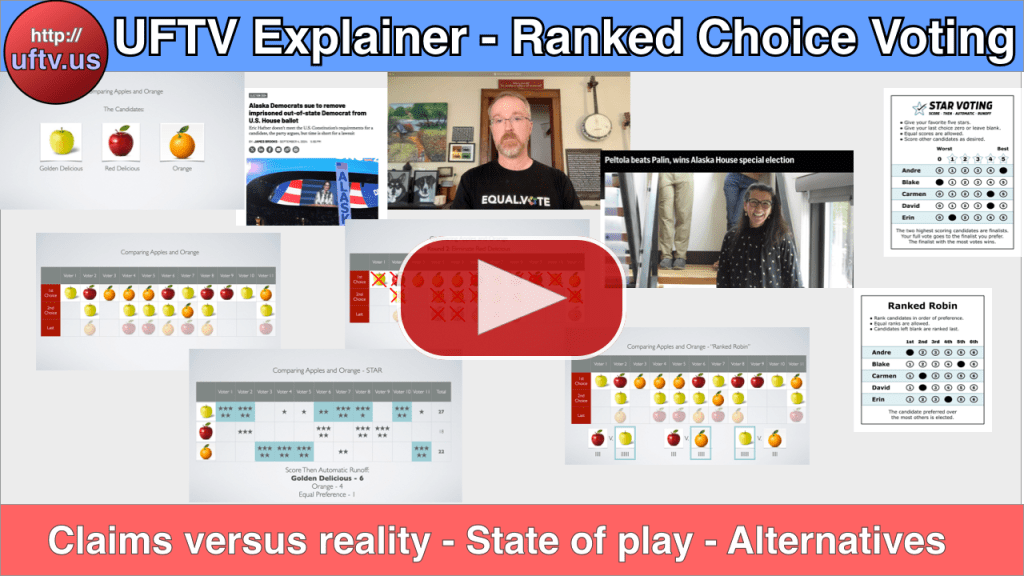
In recent years, in no small part to the increased level of fuckitude in our national politics, there has been a resurgence of interest in a rank-order voting method now known as “Ranked Choice Voting.” RCV advocates promise that RCV “guarantees winners supported by a majority of the voters” because “if your favorite is eliminated, your backup choice will be counted.” Unfortunately, these great goals are not realized by RCV. Watch the video below to learn why:
Problem 2: The Partisan Primary
The primary election system was developed more than a century ago in order to give voters the choice of which candidates should be nominated to the general election.


Unfortunately, this system which was intended to give voters more voice in the electoral process now effectively shuts out the vast majority from having a meaningful choice.
A combination of factors, including population migration (the Big Sort), the continuing exodus of voters from both major parties, and deliberate Gerrymandering (drawing district lines to advantage one of the major parties), have made the vast majority of our electoral districts and states “safe” for just one party.
When a district or state is “safe”, the determinative choice is made in the primary election, not the general, meaning that only a small fraction of voters are actually choosing our representatives, instead of We The People as a whole.
Solution: “Open” the Primary?
In the early 2000s, Washington and California adopted a new kind of primary election. Instead of separating voters and candidates by major party (and effectively excluding all not in a major party from a meaningful choice), the Top 2 Open Primary puts all the candidates on a single “choose only one” primary ballot, and all voters can participate, regardless of party affiliation. The top two plurality candidates advance to the general election, where once again, all the voters choose between them.


The Top 2 Open Primary addresses the partisan division magnified by the partisan primary system and allows participation from all voters, regardless of which direction a district tilts.
But preserving the limit of one choice in a wider field magnifies the vote-splitting spoiler inequality endemic to our voting process today. In multiple elections in Washington and California, two candidates from the minority have advanced due to vote-splitting between candidates preferred by the majority, and minor party and independent candidates have been effectively shut out from the general election where most voters participate.
Furthermore, the question of partisan association rights deserves consideration. While the claim that private political party associations have an implicit general election nomination right is unsupportable by basic democratic principles, in the Open Primary concept, a candidate can advance to the general election carrying the label (and implicit endorsement) of a party, without any partisan endorsement process. As an extreme example, the Democratic Party in Alaska has filed suit this cycle to remove an out-of-state incarcerated felon from the ballot.
Several solutions have been proposed and adopted to address some of the issues with the California and Washington Top 2:
The Unified Primary, first petitioned in Oregon in 2013, combines Approval Voting in the primary vote with a top two runoff in the general election. Voters in the primary can support all the candidates they like, the two candidates supported by the most voters advance to the general election, and all the voters can choose between the two most supported overall. St.Louis was the first city in the nation to adopt the Unified Primary for local elections in 2022.
The Unified Primary has the distinct advantage that it utilizes the same ballot format we regularly use in “choose only one” voting today, minus the one-choice limit, so adoption and education costs are minimized. Show Me Integrity, Missouri’s leading cross-partisan election reform advocacy group, is now pushing for adoption statewide and in other jurisdictions.
The Top 4 and Top 5 Open Primary efforts aim to give general election voters more than just two choices by advancing the four or five most viable candidates in the primary to the general election. Open Primaries Advocacy now counts active efforts in more than a dozen states to bring Top N Open Primaries to the voters.
The fundamental issue with Top N is that the voting method used in the general election must be able to work properly when there are more than two competitive candidates. As Alaska demonstrated in its very first use of Top 4 + Ranked Choice Voting, the RCV component of this reform falls far short of that critical goal.
If you are a passionate advocate of open primaries, we recommend pairing that reform push with a general election method that truly offers a level playing field to the candidates and an equal weight vote to all the voters, such as Approval, Ranked Robin, or STAR.
Problem 3: The Electoral College
The process for choosing our head of state is also clearly broken, but the solutions on this front are not as clear. Our processes for choosing local, state, and federal representative officers can be reformed at the local and/or statewide level, but for top dog, upgrading the mechanism of choice is a lot more complicated, and the ideal solutions less clear.
Still, the need for reform on this front is obvious. Cycle after cycle, candidates focus on fewer and fewer “swing states” – the “battlegrounds” of the choice in which We The People all have a stake. And with each cycle, the partisan rhetoric in this national contest grows ever more vitriolic, presently tearing at the very threads that bind us as a nation.
The National Popular Vote Interstate Compact effort is one leading concept that aims to start addressing this conundrum by bindinga majority of electoral college votes to the outcome of the peoples’ vote nationwide. You can learn more about that here: https://www.nationalpopularvote.com/written-explanation.
Other efforts aim to amend the Constitution itself – see https://www.brennancenter.org/issues/advance-constitutional-change/electoral-college-reform as one example.
The big challenge with Presidential election reform goes back to voting method reform. As with elections at the local, state, and federal representative levels, we clearly need a Presidential selection process that provides a level playing field for more than two candidates, and an equal weight vote for the people. Article V of the Constitution defines a pathway for this, and either a super majority of states or Congress can call this action. See https://crsreports.congress.gov/product/pdf/R/R42589/15#:~:text=If%20the%20legislatures%20of%20two,become%20part%20of%20the%20Constitution. for the deep dive on that front.
Call to Engagement
Democracy is not a spectator sport. Participating in the voting process is a good start, but the perilous deepening fracture of our broken politics demands more from us all. Learn up. Plug in. Let’s Unify The Vote!
Stories
Latest in Community
Read updates from various efforts around the nation to advance toward a more perfect union.
-
Hello World!
Welcome to the v0.001 Alpha Bravo release of http://unfuckthevote.com. We’re not quite ready for a “public launch”, but feedback is welcome!


 Unify The Vote!